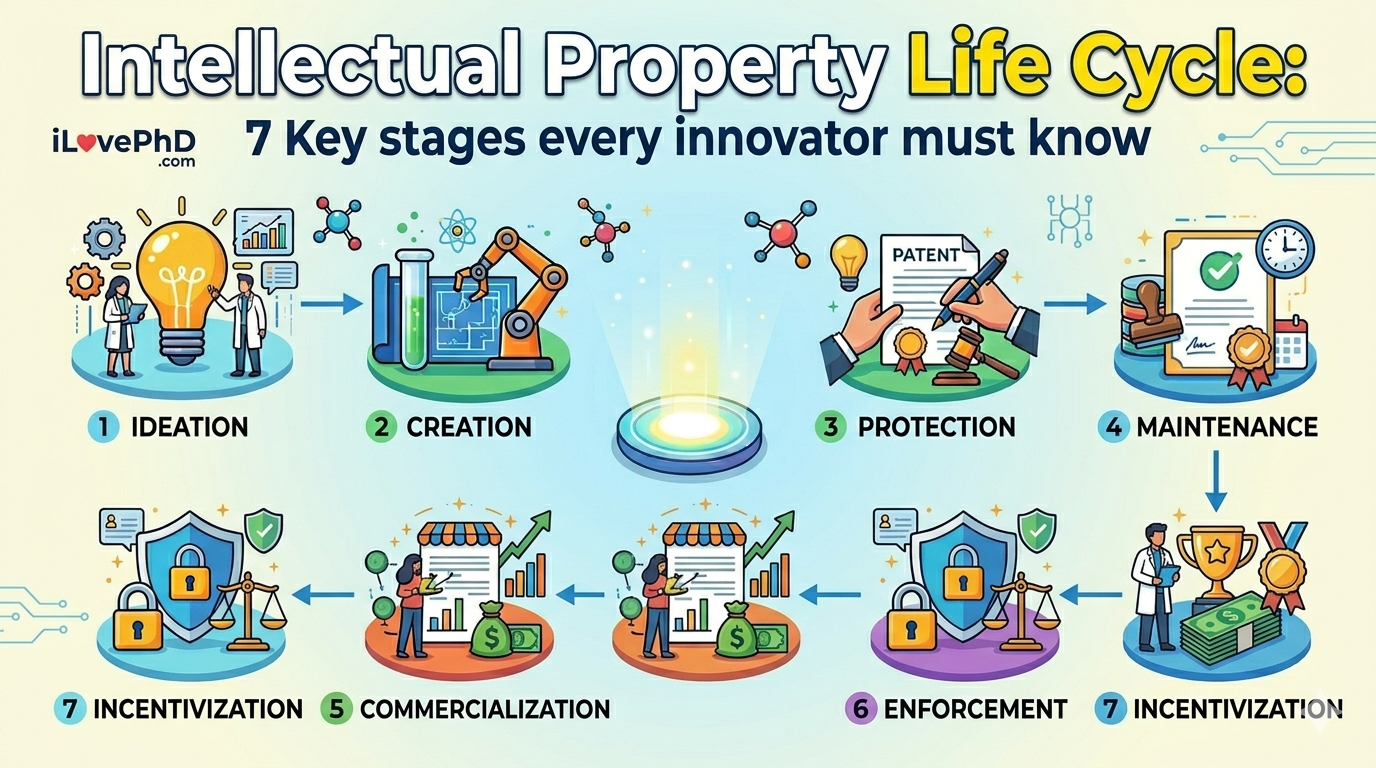
Every groundbreaking discovery begins as a thought a quiet hypothesis, a scribbled diagram at midnight, a conversation in a laboratory corridor. But the journey from that first spark to a protected, commercialized, and societally impactful innovation is anything but accidental. It is governed by one of the most powerful, yet least understood, frameworks in the modern knowledge economy: the Intellectual Property (IP) Life Cycle.
For PhD scholars, researchers, and academicians, IP is not merely a legal formality. It is the bridge between research and real-world impact. It is the mechanism by which a university invention reaches the society, a community, or an industry. In an era where research translation is as valued as research publication, understanding the IP life cycle has become an essential competency; not optional, not peripheral, but central to the identity of every serious researcher.
This article walks you through the seven interconnected stages of the IP life cycle from the first moment of ideation to the systems that incentivize future innovation with practical insights, warnings, and real-world relevance for the academic community.
Table of Contents
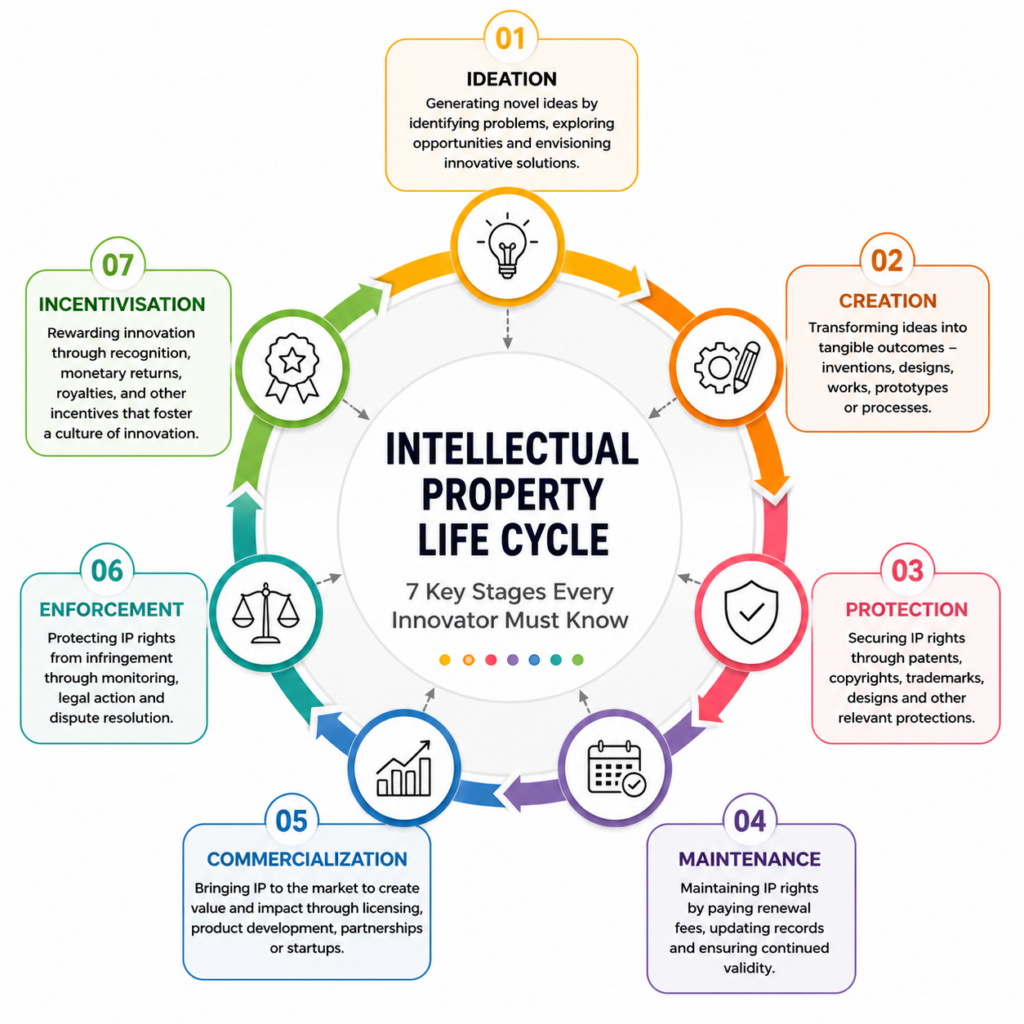
Various stages in IP life cycle
Stage 1: Ideation — The Genesis of Intellectual Value
Every IP journey begins not in a patent office, but in the mind. Ideation is the generative phase where novel concepts, observations, or solutions first emerge. In academic contexts, this often happens through curiosity-driven research, interdisciplinary dialogue, or identifying gaps in the existing literature.
What makes an idea IP-worthy?
Not all ideas qualify. For an idea to eventually earn IP protection, it must demonstrate novelty (it is new), non-obviousness (it is not a trivial extension of existing knowledge), and utility (it solves a real problem or fulfils a genuine need).
Practical Insight for Researchers:
Maintain a dated laboratory notebook or digital research log from the very beginning. This simple habit creates an evidence trail of the inception and development of your idea a document that can be critical during patent disputes or priority claims.
Best Practice:
Conduct a prior art search at the ideation stage itself. Tools like Google Patents, Espacenet, and USPTO databases help you understand the existing IP landscape before investing further effort.
Stage 2: Creation — From Concept to Concrete Form
Ideation gives birth to the concept; creation gives it form. This is the stage where the researcher actively develops, tests, refines, and documents the invention, creative work, or innovation. For a scientist, this might mean laboratory experiments. For a software developer, it means writing and testing code. For an academic author, it means drafting and structuring original intellectual content.
IP law is clear: protection is extended to the expression or embodiment of an idea, not the raw idea itself. A scientific principle, for instance, cannot be patented but the novel method of applying it, or the device built on it, can be.
Practical Insight for Researchers:
Keep meticulous records of all experiments, iterations, and failures. Document collaborators, funding sources, and timelines. These records directly support your future IP claims and can clarify co-inventorship issues a common pain point in collaborative academic research.
Recommendation:
If your research is funded by a government grant or industry sponsor, your institution or funder may have IP ownership rights. Review your funding agreement carefully before you create. Many scholars lose IP rights simply due to ignorance of contract terms.
Stage 3: Protection — Securing What You Built
Protection is the stage most people associate with IP and rightly so. It is here that the researcher, often in partnership with their institution’s technology transfer office (TTO), formally registers the IP and erects legal boundaries around it.
The key forms of IP protection include:
- Patents — for novel inventions, processes, and compositions of matter
- Copyrights — for original literary, artistic, musical, and software works (often automatic upon creation)
- Trademarks — for brand names, logos, and slogans associated with products or services
- Design Rights — for the ornamental or aesthetic aspects of a product
- Trade Secrets — for confidential business information that provides a competitive advantage
The Patent Filing Timeline is particularly critical. Most countries follow a first-to-file system, meaning the first person to file the patent wins priority; not necessarily the first to invent. This makes timely filing a non-negotiable imperative.
Practical Insight:
Before publishing your research paper, disclose your invention to your TTO. Public disclosure (including conference presentations and preprints) can destroy your patent rights in most jurisdictions. The rule of thumb: protect before you publish.
Real-World Example:
A researcher at a leading institution developed a low-cost water purification nanocomposite. Before submitting to a journal, the team filed a provisional patent application, a simple, cost-effective step that preserved their rights globally for 12 months while they prepared their full patent and journal submission simultaneously.
Stage 4: Maintenance — The Cost of Holding Ground
Protection, once granted, is not permanent by default. IP rights require active maintenance and this is where many innovators stumble. A patent, for example, must have its renewal fees paid at regular intervals (typically annually) to remain in force. Failure to pay these fees causes the IP to lapse into the public domain, where competitors may freely use it.
Copyright, by contrast, is generally automatic and long-lasting (author’s lifetime plus 60 years in most jurisdictions), but it still requires vigilance against unauthorized use.
For academic institutions and researchers:
IP maintenance is often managed by the TTO. However, if you are an independent researcher or a startup founder, this responsibility falls on you. The costs of maintenance can be significant, particularly for international patent portfolios.
Best Practice:
Periodically evaluate whether the maintained IP still holds commercial or strategic value. Not every patent needs to be renewed indefinitely. A cost-benefit analysis at each renewal point is both financially prudent and strategically sound.
Stage 5: Commercialization — Converting Value into Impact
A protected invention sitting in a filing cabinet creates no societal value. Commercialization is the transformative stage where IP is converted into economic and social benefit. For researchers, this means taking the innovation out of the lab and into the marketplace.
Key commercialization pathways include:
- Licensing — granting rights to use the IP to a company in exchange for royalties
- Spin-off / Startup creation — founding a company to develop and market the IP directly
- Technology Transfer — structured handoff to an industry partner through the institution’s TTO
- Joint Ventures and Collaborations — co-development agreements with industry partners
Practical Insight:
Licensing is often the most accessible route for academic researchers, as it allows them to retain their research focus while earning passive income and driving impact. However, the licensing terms exclusivity, territory, field of use, royalty rates must be negotiated carefully, ideally with legal support.
Recommendation:
Undervaluing your IP during commercialization is a common and costly mistake. Seek a formal IP valuation before entering negotiations. Know your leverage.
The commercialization stage is also where the IP connects to the broader innovation ecosystem incubators, venture capital, industry consortia, and government innovation programs all play significant roles in accelerating this journey.
Stage 6: Enforcement — Protecting Your Position
Securing IP rights is one challenge; defending them is another. Enforcement is the active process of monitoring the marketplace for infringement and taking appropriate legal or administrative action when violations occur.
For researchers who have commercialized their IP, enforcement is an ongoing responsibility. It may involve:
- Monitoring competitor products and publications for potential infringement
- Sending cease-and-desist notices to infringers
- Filing litigation in court or through IP tribunals
- Using alternative dispute resolution (ADR) mechanisms like mediation and arbitration
Enforcement can be costly and time-consuming, particularly in cross-border scenarios. This is why robust IP protection (Stage 3) and proactive monitoring (Stage 4) are critical foundations.
Practical Insight:
Document infringement carefully before acting. Gather dated evidence product samples, advertisements, screenshots, publications before initiating any legal action. Premature or poorly evidenced enforcement actions can backfire.
In academic settings, researchers should also be vigilant about IP misappropriation within collaborations instances where a collaborator, without authorization, uses, modifies, or publishes protected IP. Clear IP ownership clauses in all collaboration agreements are the best preventive measure.
Stage 7: Incentivization — Closing the Loop, Fuelling the Next Cycle
The IP life cycle does not end with enforcement — it renews through incentivization. This final stage refers to the systems, mechanisms, and cultures that motivate researchers and innovators to generate new IP, thereby sustaining the entire cycle.
Incentivisation operates at multiple levels:
- Financial incentives — royalty sharing between the inventor and institution; research grants linked to IP output
- Career incentives — patent counts and technology transfer activities increasingly recognized in academic promotion criteria
- Policy incentives — national IP policies (such as India’s National IPR Policy 2016) that encourage university-industry technology transfer
- Cultural incentives — building a research culture that celebrates innovation and translation, not just publication
Best Practice for Institutions:
A fair and transparent royalty-sharing policy is one of the most powerful motivators for researcher participation in the IP system. Researchers who see tangible returns from their innovations are significantly more likely to disclose future inventions.
For PhD scholars, understanding what rewards await at the end of the IP journey financial, reputational, and societal which provides the motivation to engage seriously with IP from the very beginning.
Why the IP Life Cycle Is Indispensable for Researchers and Innovators
The importance of IP literacy for the academic community cannot be overstated. Here is why:
1. Research Translation is Now an Academic Expectation: Funding bodies, institutions, and governments are increasingly measuring research impact not just in citations, but in patents, licenses, and startups. Understanding the IP life cycle positions researchers to participate meaningfully in this translation economy.
2. IP Protects Researcher Interests: Without IP awareness, researchers may unknowingly sign away their rights, co-invent without recognition, or publish prematurely and forfeit patent eligibility. Knowledge is the first line of defence.
3. IP Enables Ethical Collaboration: Clear IP frameworks in collaborative research prevent disputes, protect contributions, and create fair frameworks for benefit-sharing essential in interdisciplinary and international partnerships.
4. IP Creates Societal Impact: When research is protected and commercialized effectively, it reaches patients, farmers, consumers, and communities. IP is the mechanism by which academic knowledge becomes societal value.
Conclusion:
The IP life cycle is, at its heart, a story of human ingenuity one that begins with curiosity, is disciplined by process, protected by law, amplified by commerce, defended by vigilance, and reinvigorated by incentive. For PhD scholars and researchers, engaging with this cycle is not a bureaucratic obligation; it is an act of responsibility toward the knowledge you create and the society you serve.
Your next idea, the one forming right now as you read this, deserves to be protected, developed, and delivered to the world. Understanding the IP life cycle is not just professional preparation; it is intellectual stewardship.
In the words of Thomas Edison: “The value of an idea lies in the using of it.” Build the knowledge. Protect the asset. Create the impact.
Related Articles on iLovePhD:
- Top 12 Patent Funding in India 2026
- Technology Readiness Level (TRL), IP and Startup
- Know the Importance of Expedited Patent Application in India
- Patent Search Techniques: How Patent Professionals do it
About The Author
